Despite the fears that data centers will cause a precipitous rise in electricity rates, there are clear examples demonstrating how these fears are unfounded or at best overstated. The I&M Indiana rate case is only the latest example of how load growth can place downward (not upward) pressure on rates. How is that possible?
Fundamentally, a rate is defined as follows:
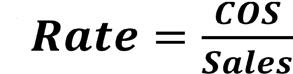
Where: COS is the cost of providing service, and
Sales reflect how electricity is utilized.
What this simple equation demonstrates is that when costs are rising faster than sales, rates will increase. But the opposite is also true: when sales are increasing faster than costs, rates will decrease.
Data centers are very large loads, but they operate at extremely high load factors. A high load-factor means that a customer is more fully utilizing its peak demand. Thus, data centers not only increase peak demand, they also increase utilization. Higher utilization means that fixed costs can be spread over a larger sales base, thereby putting downward pressure on rates.
Until recently, utilization has been decreasing. Utilities experienced only modest organic load growth, but the generation that was added to the grid was largely comprised of intermittent (wind/solar) resources and batteries, which effectively reduced utilization. The Inflation Reduction Act of 2022, which encouraged even more intermittent wind and solar additions and accelerated the retirement of dispatchable around-the-clock fossil fuel plants, exacerbated the decline. This is why electricity rates have increased faster than inflation since 2022.
The addition of data center loads fundamentally reverses the decline in utilization.
Therefore, charging data centers cost-based rates, coupled with appropriate guardrails such as minimum demand charges, longer contract terms, and credit support, should ensure that data centers fully pay for the incremental costs that they cause. This is consistent with the pledge that many tech companies have signed, and it is also the centerpiece of the Ratepayer Protection Act, which is pending in Congress. Because data centers will increase utilization, rates for existing customers should decrease.
Unprecedented load growth prompts Ind. rate reduction filing from AEP utility
Russell Ernst • S&P Global Energy
Tuesday, September 1, 2026 3:24 PM CT
American Electric Power Co. Inc. subsidiary Indiana Michigan Power Co. recently filed a multiyear rate plan proposal with the Indiana Utility Regulatory Commission that calls for the use of a variety of credits and deferrals that would initially reduce rates for most customers and keep rates stable for the final two years of the plan.

➤ Indiana Michigan Power seeks to reduce its nonfuel rates by $42 million for non-large-load customers during the first year of its multiyear rate plan (MYRP) in 2027, and implement a mechanism that would allow rates to be further reduced in that year. In 2028 and 2029, rates would only be amended through certain riders for various non-residential customer classes. The mechanism accounts for increased base rate revenue requirements in the final two years of the plan.
➤ The enactment of House Bill (H.B.) 1002 earlier in 2026 requires the state’s electric utilities to seek Indiana Utility Regulatory Commission (URC) approval of MYRPs that are to incorporate performance incentive metrics. This MYRP application marks the first such filing for an Indiana utility.
➤ Utility rate affordability has been a major issue lately in Indiana. The utilities weighed in on a URC investigation of the matter during sessions held in March, and ratepayers had an opportunity to share their concerns with regulators. Gov. Mike Braun (Republican) subsequently took issue with the outcome of another utility’s electric rate case in June, and later removed a member of the commission. These developments are noteworthy for industry stakeholders and add considerable uncertainty to the state’s regulatory climate.

In Ca-46454, Indiana Michigan Power filed its MYRP for the years 2027-2029, pursuant to a state law enacted in April. Changes in revenue from expected load growth attributable to new large-load customers and certain features of a reduce-and-freeze (RAF) mechanism would be used to offset increased base rate revenue requirements in the second and third years of the MYRP, mitigating the company’s need for base rate adjustments during those years.
Specifically, the utility seeks to reduce its nonfuel rates by $42 million for non-large-load customers during the first year of the plan (for a test year ending Dec. 31, 2027), and implement the RAF mechanism to allow rates to be further reduced in 2027, and for overall rates to be stabilized in 2028 and 2029. In 2028 and 2029, rates would only be amended through certain riders for various non-residential customer classes.
For residential customers, the rate reduction in 2027 would be approximately 5%; for all other non-large-load customers, the reduction would be roughly 2%.
The company proposes a 10.10% return on equity (46.18% of a regulatory capital structure) and a 6.89% return on a $7.613 billion rate base for use in calculating its base rate revenue requirement in 2027. For 2028, a 10.10% return on equity (47.59% of a regulatory capital structure) and a 7.28% return on a $9.101 billion rate base was used; and for 2029, a 10.10% return on equity (47.56% of a regulatory capital structure) and a 7.31% return on a $11.510 billion rate base was used. The filing relies upon a year-end rate base methodology.
The RAF mechanism would incorporate a regulatory liability associated with a large-load-related deferred balance previously approved by the URC; production tax credits generated by the Donald C. Cook Nuclear Power Plant; renewable energy credit sales proceeds from generation assets reflected in the MYRP forecast; adjustments stemming from the RAF mechanism’s earnings test; amortization of any RAF regulatory liability; and a return on the deferral balance throughout the term of the MYRP.
The RAF earnings test would compare Indiana Michigan Power’s actual net operating income during each year of the MYRP to the maximum allowable net operating income calculated for each year. A regulatory asset or liability would be established for the difference. The RAF earnings test would replace the statutory earnings test currently included in the company’s fuel adjustment clause (FAC) filings.
Without the RAF mechanism, Indiana Michigan Power said its rates would need to increase in total in 2028-2029 by nearly $499 million, and many of the company’s riders would also cause additional “rate variability” during the term of the plan. The company said the mechanism “addresses that variability by capturing it in a deferred balance instead of allowing it to flow directly into customer rates.”
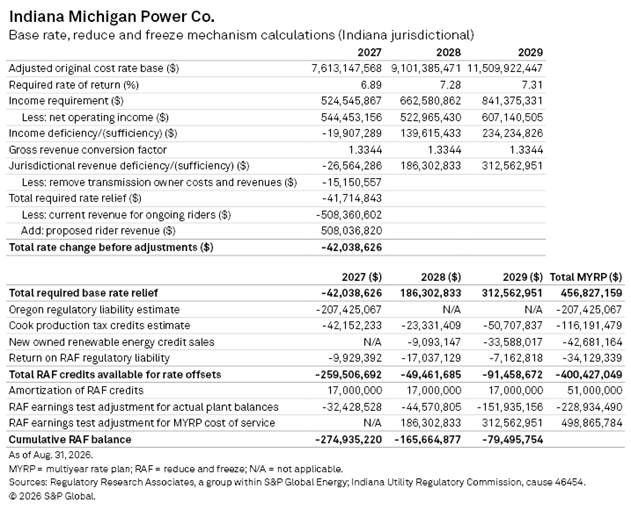
All other rider rates for the company, excluding the off-system sales/PJM Interconnection rider for large-load customers and the FAC for non-residential customers, would remain frozen at 2027 levels throughout the MYRP period. Indiana Michigan Power would annually review and reconcile each rider’s over- or under-recovery balance in a separate filing, and would include the resulting positions in the total RAF mechanism regulatory asset or liability balance.
The company defines a large-load customer as an entity whose contract capacity is at least 70 megawatts or is expected to grow to exceed that threshold at an individual plant, or 150 MW or is expected to grow to at least that level at one or more aggregated sites. Indiana Michigan Power currently has three large-load customers that have signed electric service agreements with it pursuant to a tariff adopted in early 2025 in Ca-46097 that provides for the utility’s large load customers to be subject to an extended initial contract term, a predetermined load ramp period, contract capacity commitments and other terms of service.
The utility said it expects to invest $11.7 billion in generation, transmission and distribution infrastructure over the 2027-2029 period. Several new generation projects are being pursued, as is a license extension for units 1 and 2 at the Cook plant, which would extend their service lives through 2054 and 2057, respectively.
The utility said its “economic development efforts have secured unprecedented load growth that is expected to more than double Indiana-jurisdictional [peak] load from approximately 2,800 MW in 2024 to more than 7,000 MW by 2032.”
Indiana Michigan Power also seeks to establish a regulatory asset for costs associated with vegetation management work on the company’s distribution system; certain costs related to the former Breed generation facility; and costs tied to Rockport unit 1’s planned retirement in 2028.
Customer affordability and service restoration performance metrics are included in the proposal, in accordance with the provisions of the MYRP law, which could increase or decrease the approved equity return by up to 1.5 basis points.
Indiana Michigan Power said the instant filing is driven by the need to align its rates with Indiana’s energy policy framework (including the statutory “five pillars” outlined in state law, namely reliability, affordability, resiliency, stability and environmental sustainability), the MYRP statute and the URC’s July 2026 report that addresses utility rate affordability.
A procedural schedule was proposed that would provide for intervenor testimony to be filed Dec. 2; company rebuttal testimony to be filed Dec. 30; a hearing to begin Jan. 20, 2027; and issuance of a final order by June 23, 2027.
Indiana Michigan Power’s most recent base rate case in Indiana (Ca-45933) was decided in 2024, when the URC adopted most of the provisions of a settlement, allowing for implementation of a two-step base rate increase. However, a roughly $2.6 million investment in fast-charging EV equipment was excluded from the company’s revenue requirement. The settlement had called for a $61.8 million base rate hike reflecting a 9.85% return on equity. Indiana Michigan Power initially sought a $116.4 million base rate increase premised upon a 10.50% ROE.
Indiana Michigan Power serves roughly 486,000 retail customers in Indiana and an additional 133,000 ratepayers in Michigan.
New ratemaking paradigm
The enactment of H.B. 1002 alters the ratemaking approach used for Indiana’s electric utilities since 2013. The new law requires the electric utilities to request URC approval of MYRPs that are to be in place for three-year terms and allows for annual base rate adjustments that reflect forward-looking test years. The commission is to consider the impact of the plans on each utility’s risk profile when it determines an appropriate ROE. The plans are to incorporate performance metrics pertaining to affordability and service restoration that would allow financial penalties or rewards to be assessed to the utilities.
Braun signed H.B. 1002 into law in February, and in a press release issued April 6 said: “Affordability is this administration’s top priority, and high electricity prices have placed a major burden on Hoosiers’ wallets.”
The plans are to include customer affordability and service restoration performance metrics.
In addition, the new law allows the URC to request that the governor declare a “state of energy emergency” if certain conditions were to arise, namely a national economic depression, an act of war or “a disaster of unprecedented size and destructiveness resulting from manmade or natural causes.” In such a circumstance, the commission would be permitted to temporarily amend or suspend the rates charged by the utilities under its purview.
Gubernatorial actions and commission focus on affordability
Braun has been payingconsiderable attention to utility rate affordability. In addition to signing H.B. 1002 into law in February, he appointed Abby Gray to lead the Indiana Office of Utility Consumer Counselor (OUCC) in September 2025. Gray previously served as the OUCC’s Executive Director of Legal Operations and was a senior administrative law judge at the URC.
Braun subsequently made changes to the composition of the URC. He appointed Andy Zay (Republican), Bob Deig (Democrat) and Anthony Swinger to serve on the commission following the departures of former Chairman Jim Huston (Republican), Sarah Freeman (Democrat) and Wesley Bennett (Republican). Deig and Swinger are to serve terms extending to January 2030. Zay was appointed chairman and his term was to expire in April 2030; however, following the June 2026 rate case decision for AES Corp. subsidiary Indianapolis Power and Light, which does business as AES Indiana, Braun removed Zay from the commission and replaced him with Joshua Bain (Republican). Joby Jerrells (Republican) was subsequently appointed to replace David Veleta, who left the commission. The other member of the URC is David Ziegner (Democrat), whose term expires in April 2027.
Customer affordability has been making headlines in Indiana. The URC began an inquiry in March into the matter in accordance with directives from Braun. At that time, the commission obtained input regarding billing practices and increasing energy costs from representatives of the utilities subject to its jurisdiction, namely Indianapolis Power and Light; CenterPoint Energy Inc. subsidiaries Southern Indiana Gas and Electric Co. and Indiana Gas Co. Inc.; Duke Energy Corp. subsidiary Duke Energy Indiana LLC; Indiana Michigan Power and NiSource Inc. subsidiary Northern Indiana Public Service Co. LLC (NIPSCO).
The URC subsequently held several “listening sessions” on rate affordability across the state and, in July, issued a report on energy affordability that addressed implementation of the new ratemaking law and set the commission’s expectations for the utilities to improve their overall customer service and education practices.
In Ca-46428, the URC is conducting an investigation of risk associated with MYRPs, and in Ca-46429, the use of rate riders in MYRPs is being given attention by the commission.
RRA view on Indiana regulatory climate
Historically, Indiana regulation for energy utilities was relatively constructive from an investor perspective. State law permits certain costs associated with electric and gas projects to be addressed outside traditional base rate proceedings, thereby mitigating regulatory lag. Existing adjustment clauses provide for timely recovery of various costs, including bad debts, energy efficiency programs, gas commodity, and electric fuel and purchased power. The utilities have long been subject to a net operating income test that could limit their ability to recover a portion of their fuel-related costs. Typically, however, the utilities accrue significant “under-earning banks” that limit their exposure to fuel cost recovery prohibitions.
Continued observation of the regulatory environment by those with a stake in Indiana’s utility industry is justified.
In the aforementioned rate case (Ca-46258) decision for Indianapolis Power and Light issued in June 2026, the URC adopted a settlement, with modifications, that provided for a $346.1 million two-step base rate increase for its electric operations. The net increase to ratepayers was determined to be about $71.1 million after accounting for revenues collected through certain riders. The settlement had called for a $365.7 million base rate increase. The URC reduced the stipulated 9.75% ROE to 9.50%, citing affordability concerns, and reduced the amount to be included in base rates for vegetation management expenses.
Indianapolis Power and Light parent AES Corp. also recently agreed to be acquired by an investor group led by Global Infrastructure Management LLC and EQT Partners AB. The transaction does not require URC approval to proceed.
Ohio Valley Gas Inc. is also subject to the URC’s jurisdiction.
Regulatory Research Associates is a group within S&P Global Energy.
S&P Global Energy produces content for distribution on S&P Capital IQ Pro.
For a full listing of past and pending rate cases, rate case statistics and upcoming events, visit the S&P Capital IQ Pro Energy Research Home Page.
For a complete, searchable listing of RRA’s in-depth research and analysis, visit the S&P Capital IQ Pro Energy Research Library.
This article was published by S&P Global Market Intelligence and not by S&P Global Ratings, which is a separately managed division of S&P Global.